
Engineering design is not just about creating machines or structures that work—it is about ensuring they work safely and reliably under real-world conditions. Components often experience unpredictable loads, environmental conditions, and material imperfections. To account for these uncertainties, engineers use an essential concept known as the Factor of Safety (FoS).
The Factor of Safety is a design principle that ensures a component or structure can withstand loads greater than what it will normally experience during operation. Without it, bridges, buildings, machines, and even everyday products could fail unexpectedly.
In this article, we will explore the basic concept of Factor of Safety, look at practical examples, and review common interview questions that engineering students frequently encounter.
1. Basic Concept of Factor of Safety
What is Factor of Safety?
The Factor of Safety (FoS) is the ratio between the maximum stress a material can withstand and the actual stress applied during operation.
It provides a margin of safety between design limits and failure limits.
Formula
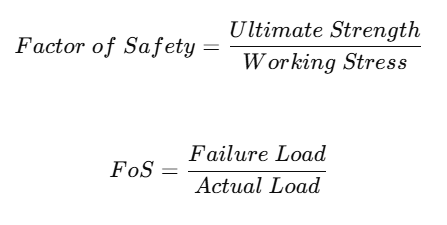
Where:
- Ultimate Strength – Maximum stress the material can handle before failure
- Working Stress – Stress expected during normal operation
For example:
If a steel component can withstand 400 MPa before breaking but is designed to experience only 100 MPa, then:
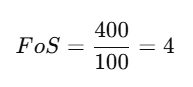
This means the component is four times stronger than required for normal operation.
Why Factor of Safety is Important
The Factor of Safety is essential because real-world conditions are rarely perfect. It helps engineers account for uncertainties such as:
- Material defects
- Unexpected loads
- Manufacturing errors
- Fatigue and wear
- Environmental factors (temperature, corrosion)
Without an adequate FoS, structures may fail even if calculations appear correct.
For example, the American Society of Mechanical Engineers (ASME) provides design standards that include safety factors for pressure vessels and mechanical components.
External reference:
ASME standards – https://www.asme.org
Another useful engineering reference:
Engineering Toolbox – https://www.engineeringtoolbox.com/factor-safety-d_1624.html
Typical Factor of Safety Values
Different applications require different safety margins.
| Application | Typical FoS |
|---|---|
| Structural steel | 1.5 – 2 |
| Bridges | 2 – 3 |
| Pressure vessels | 3 – 4 |
| Aircraft components | 1.5 – 2 |
| Heavy lifting equipment | 4 – 6 |
Higher FoS values are used when failure could cause serious damage or loss of life.
Types of Safety Factors
1. Ultimate Safety Factor
Based on ultimate strength of the material.
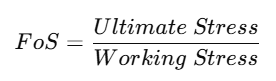
This is common in structural engineering.
2. Yield Safety Factor
Used when deformation must be avoided.
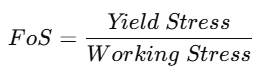
This ensures that the material does not permanently deform.
3. Design Factor
Sometimes called the Design Safety Factor, this value is chosen by engineers during the design stage to ensure reliability.
Design standards such as ISO, ASME, and ASTM often specify recommended values.
Learn more about engineering design standards:
https://www.iso.org/standards.html
Factors Affecting the Choice of Safety Factor
Selecting the correct FoS is not random. Engineers consider several variables:
1. Type of Load
Loads may be:
- Static
- Dynamic
- Impact
- Cyclic (fatigue)
Dynamic loads require higher FoS.
2. Material Properties
Different materials behave differently under stress.
For example:
- Steel – predictable behavior
- Cast iron – brittle failure
- Aluminum – fatigue-sensitive
This influences the required safety margin.
3. Consequences of Failure
Critical structures require larger safety margins.
Examples:
- Aircraft parts
- Bridges
- Medical equipment
In such cases, engineers may use FoS values above 4 or even higher.
4. Environmental Conditions
Factors such as:
- Corrosion
- Temperature
- Moisture
- Vibration
can weaken materials over time.
Designers account for these by increasing FoS.
2. Practical Examples of Factor of Safety
Understanding FoS becomes easier when we examine real-world engineering scenarios.
Example 1: Crane Cable
A crane cable is used to lift 10,000 N loads.
The cable can withstand 50,000 N before breaking.
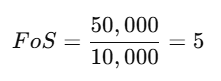
This means the cable has five times the strength needed, making it safe for lifting heavy loads.
This is why lifting equipment often has high safety factors.
Example 2: Bridge Design
Bridges carry vehicles, pedestrians, and sometimes heavy trucks.
Engineers cannot predict exact loads at all times.
Therefore, they use safety factors between 2 and 3 to ensure structural reliability.
For example:
If a bridge beam experiences 200 MPa stress, but the steel has a yield strength of 400 MPa, then: FoS=400/200=2
This provides a safety margin against overload.
Reference:
Bridge engineering fundamentals – https://www.fhwa.dot.gov/bridge/
Example 3: Pressure Vessels
Pressure vessels used in industries like oil and gas operate under extreme internal pressure.
A pressure vessel might experience 50 MPa working stress.
If the material has 200 MPa ultimate strength: FoS=20050=4FoS = \frac{200}{50} = 4FoS=50200=4
Due to catastrophic consequences of failure, pressure vessels often have high safety factors.
Reference:
Pressure vessel design basics – https://www.engineeringtoolbox.com/pressure-vessels-d_1106.html
Example 4: Consumer Products
Even everyday products use FoS.
Examples include:
- Chairs
- Ladders
- Car jacks
- Hand tools
A ladder rated for 120 kg might actually support 300 kg before failure.
This ensures safety during unexpected conditions.
3. Advantages of Using Factor of Safety
Using FoS provides several benefits in engineering design.
Improved Reliability
Components are less likely to fail unexpectedly.
Better Durability
Higher safety margins help components withstand wear, fatigue, and aging.
Protection Against Uncertainty
Engineering calculations may not perfectly predict real-world conditions.
FoS compensates for:
- Design assumptions
- Material variations
- Manufacturing tolerances
Compliance with Engineering Standards
Many engineering codes require minimum safety factors.
Examples include:
- ASME Boiler and Pressure Vessel Code
- ISO design standards
- ASTM material standards
Reference:
ASTM International – https://www.astm.org
4. Limitations of Factor of Safety
Although FoS improves safety, it has some limitations.
Overdesign
Excessively high safety factors increase:
- Material cost
- Weight
- Manufacturing complexity
Reduced Efficiency
In industries like aerospace, heavy components reduce performance.
Therefore, designers carefully balance safety and efficiency.
Not a Replacement for Good Design
FoS cannot compensate for poor engineering practices.
Engineers must still consider:
- Proper material selection
- Accurate stress analysis
- Testing and validation
5. Factor of Safety in Modern Engineering
Modern engineering increasingly uses advanced analysis techniques to optimize safety.
Examples include:
Finite Element Analysis (FEA)
FEA software simulates stresses in complex components.
Popular tools include:
- ANSYS
- SolidWorks Simulation
- Abaqus
These tools allow engineers to evaluate safety factors across entire structures.
Reliability-Based Design
Instead of a fixed FoS, some industries use probability-based safety analysis.
This approach evaluates the likelihood of failure rather than relying solely on fixed safety margins.
It is commonly used in:
- Aerospace engineering
- Nuclear engineering
- Automotive safety systems
6. Interview Questions on Factor of Safety
Here are some frequently asked questions in mechanical engineering interviews.
1. What is the Factor of Safety?
The Factor of Safety is the ratio of maximum strength of a material to the allowable working stress.
2. Why is the Factor of Safety used in design?
It provides a margin of safety to account for uncertainties such as material defects, unexpected loads, and environmental effects.
3. What is the formula for Factor of Safety?
FoS=Ultimate StrengthWorking StressFoS = \frac{Ultimate\ Strength}{Working\ Stress}FoS=Working StressUltimate Strength
4. What is the difference between Yield Safety Factor and Ultimate Safety Factor?
- Yield FoS prevents permanent deformation.
- Ultimate FoS prevents complete failure or fracture.
5. Why do bridges use higher safety factors?
Because bridge failure could cause large-scale damage and loss of life, requiring extra safety margins.
6. Can the Factor of Safety be too high?
Yes. Extremely high FoS leads to overdesign, increasing cost and weight unnecessarily.
7. What safety factor is used in lifting equipment?
Typically 4 to 6, depending on load conditions and safety regulations.
Conclusion
The Factor of Safety is one of the most fundamental concepts in engineering design. It ensures that structures and machines remain safe even when conditions differ from theoretical calculations.
By introducing a margin between working loads and failure limits, engineers can design systems that withstand uncertainties such as material defects, unexpected forces, and environmental factors.
From bridges and cranes to pressure vessels and everyday consumer products, the Factor of Safety plays a crucial role in preventing failures and protecting human life.
Understanding this concept is essential for engineering students, practicing engineers, and anyone involved in design, manufacturing, or structural analysis.
When applied correctly, the Factor of Safety helps achieve the perfect balance between safety, efficiency, and cost-effective engineering design.